Thursday, November 22, 2012

Annapurna Mountain

Annapurna, a collosal masiff is placed as the tenth tallest mountain in the world. Kali Gandaki river segregates Annarpurna mountain range from the great gorge that slices through the Himalayas. Range of Mount Annapurna holds huge glaciers on its slopes.


The short note about Annapurna MountainAnnapurna Mountain


Location Central Nepal Himalayas
Altitude 8,091m
Importance 10th Highest Mountain In The World
Best Time To Visit April To October


Major Peaks of The Annapurna Range


Annapurna I 26,545 ft. 8,091 m.
Annapurna II 26,040 ft. 7,937 m.
Annapurna III 24,786 ft. 7,555 m.
Annapurna IV 24,688 ft. 7,525 m.
Gangapurna 24,457 ft. 7,455 m.
Annapurna South 23,684 ft. 7,219 m   

 The trek to Annapurna mountain takes the tourists very very close to nature. The trek is a marvellous combination of being spiritually soothing and highly adventurous. The following places are the trek's highlights.


  • Pewa Lake Pokhara
  • Gurung Villages, Langdrung and Gandrung
  • Hinko Cave
  • Bamboo Forests
  • Machapuchare Base Camp
  • Annapurna Base Camp 
  • Annapurna, one of Nepal's renowned mountain ranges, comprises an array of peaks, all of astounding heights. Of these, Annapurna I and Annapurna II are the highest at almost 8000 meters, offering beautiful impressive view for anyone trekking through the Himalayas.

Manaslu Mountain

Manaslu, the eighth tallest mountain on the planet, presents one of the most challenging treks in Nepal. Manaslu mountain stands in the vicinity of Annapurna. Thanks to its peculiar appearance, Manaslu mountain peak can be noticed from afar for it juts out steeply above its neighboring landscape. Elongated ridges and valley glaciers provide comparatively easy approach to the mountaineers.


We can note a little about Manasulu Mountain as follow:

Location West Central Nepal
Altitude 8,156m (26758 ft)Manaslu
Importance 8th Highest Mountain in the World
Mountain Range Himalaya
Region Manaslu Himal
Convenient Center Pokhara
Nearest major Airport Kathmandu
Best Trek Season April To May & Late September To October
 Manslu treks offer a chance to experience the untouched region of Nepal. Number of tourists coming in area have been restricted to preserve the freshness of the area. The government wants to save the region from undue commercialisation. Thanks to this approach, the travellers get the opportunity to enjoy refreshing atmosphere of the trekking circuit. Here is possible itinerary of Manaslu trek.

Sunday, November 11, 2012

Dhaulagiri from ramrekha.jpgDhaulagiri is the seventh highest Mountain in the world at 8,167 metres (26,795 ft) and is one of fourteen over eight thousand meters. Dhaulagiri, which is in Nepal, was first climbed on May 13, 1960 by a Swiss/Austrian expedition.
The mountain's name is dhaulāgirī dhawalāgirī in  Hindi and Nepali. This comes from Sanskrit  where(dhawala) means dazzling, white, beautiful and  (giri) means mountain.It is often called Dhaulagiri I, denoting the highest summit  in its massif  called Dhaulagiri Range (Nepali , shrinkhalā), Dhaulagiri Himāl or The Dhaulagiris. This massif extends 120 km from the Kaligandaki Rivr west to the Bheri . Dhaulagiri I is the easternmost high peak. Dhaulagiri I is also the highest point of the Gandaki river basin.Annapurna
 (8,091m/26,545 ft) is only 34 km. east of Dhaulagiri I. TheKaligandaki river  flows between through its notable, said to be the world's deepest. The town Pokhara is south of the Annapurnas, an important regional center and the gateway for climbers and Trekkers visiting both ranges as well as a tourist destination in its own right.

Cho Oyu Mountain

ChoOyu-fromGokyo.jpgCho Oyu is the sixth highest mountain in the world, located a short distance to the west from Everest (the highest) and Lhotse (the fourth highest) in the Khumbu region of Eastern Nepal along the Tibetan border. Its towering peak stands with Everest well above the surrounding mountains. It became a familiar landmark to climbers ascending Everest's north face. Just west of Cho Oyu is the Nangpa La, a 19,000-foot glacier pass, the main trade route between the Khumbu Sherpas and Tibet.
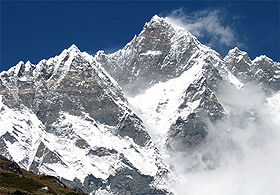
 The mountain is the westernmost major peak of the Khumbu sub-section of the Mahalangur Himalaya  20 km west of Mountain Everest. The mountain stands on the Tibet-Nepal border.
Just a few kilometres west of Cho Oyu is Nangpa La (5,716m/18,753 ft), a glaciated pass that serves as the main trading route between the Tibetans and the khumbu's. This pass separates the Khumbu and Rolwaling Himalayas. Due to its proximity to this pass and the generally moderate slopes of the standard northwest ridge route, Cho Oyu is considered the easiest 8.00 meter peak to climb, It is a popular objective for professionally guided parties.

Saturday, November 10, 2012

Makalu Mountain

Mount Makalu, holding its place among mountains in world at fifth place, is located nearly 14 miles away from Mount Everest. Structure quite similar to a pyramid makes the mountain look unique. Nature has blessed the region with unbelievable diversity of beauty. Attractions like Great Himalayan peaks carpeted by snow, quaint villages, exotric villages and impressive riversided never cease to impress tourists who have come for trek. It is located China-Nepal border and its altitude is 8,463m it is 5th highest peck in the world. Many tourists come to treak this mountain. Its good seaso fortreking is from May and september to october. It is located Khumbu Himal region of Nepal.


Makalu
The makalu mountain


Lhotse Mountain

The Lhotse Mountain is located in Nepal of Asia.Lhotse, also called LhotseMountain.jos.500pix.jpg
one of the world’s highest mountains (27,890 feet [8,501] m]), consisting of three Himalayan summits on the Nepalese-Tibetan (Chinese) border just south of Mount Everest, to which it is joined by a 25,000-foot (7,600-metre) ridge. On May 18, 1956, Fritz Luchsinger and Ernest Reiss, two Swiss climbers, made the first ascent of the mountain. It is sometimes considered part of the Mount Everest massif. Lhotse is Tibetan for “south peak”; E1 was the original survey symbol (denoting Everest 1) given by the Survey of India (1931).

Lhotse   is the fourth highest Mountain on Earth after Mountain Everest and Kanchenjunga and  and is connected to Everest via the South Col. In addition to the main summit at 8,516 metres (27,940 ft) above sea level, Lhotse Middle (East) is 8,414 metres (27,605 ft) and Lhotse Shar is 8,383 metres (27,503 ft). It is located at the border between Tibet of china and the Khumbu region of Nepal.

The  Elevation of Lhotse is 27,890 feet 8,501 meters and its Location is  Nepal, Asia
First Ascent of  its are  Fritz Luchsinger and Ernst Reiss of Switzerland on May 18, 1956.

How was theKanchengunga Mountain named ?


Kangchenjunga is the official spelling adopted byDouglas Freshfield , A.M. Kellas, and the Rooyal Geographical Society that gives the best indication of the Tibetain.
The name Kangchenjunga is derived from Sanskrit kanchana ganga: kanchana means gold and ganga is  the river which flows in the region. The river shines like gold and hence the name Kanchana Ganga was given to this mountain. Its name in Nepali is Kanchanjaŋghā. Its name in the local Limbu language, meaning "mountain that we offer greetings to". Sewalungma is considered sacred by adherents of the Kirant religion.
There are a number of alternative spellings which include Kangchen Dzö-nga, Khangchendzonga, Kanchenjanga, Kachendzonga, Kanchenjunga or Kangchanfanga. The final word on the use of the name Kangchenjunga came from His Highness Sir Tashi Namgyal, the Maharaja or chogyall of Sikkim, who stated that "although junga had no meaning in Tibetan, it really ought to have been Zod-nga (treasure, five) Kang-chen (snow, big) to convey the meaning correctly". Following consultations with a Lieutenant-Colonel J.L.R. Weir (British political agent to Sikkim), he agreed that it was best to leave it as Kangchenjunga, and thus the name remained so by acceptance and common usage.

The location of kanchengunga in the world map


Kanchenjunga is the third highest mountain in the world, with an elevation of 8,586 m (28,169 ft) and located along the India-Nepal border in the Himilayas. Kangchenjunga is also the name of the surrounding section of the Himalayas and means "The Five Treasures of Snows", as it contains five peaks, four of them over 8,450 m (27,720 ft). The treasures represent the five repositories of God, which aregold, silver, gems, grain and holy books.
Three of the five peaks – main, central, and south – are on the border of North Sikkim in Indiaand Taplejung district of Nepal, while the other two are completely in Taplejung District. The Kangchenjunga Himal, or region, includes twelve more peaks over 7,000 m (23,000 ft).
Until 1852, Kangchenjunga was assumed to be the highest mountain in the but calculations based on various readings and measurements made by the  Great Trigonometric Survey of India in 1849 came to the conclusion that Mount Everest (known as Peak XV at the time) was the highest. It would be 1856, allowing for further verification of all calculations, before it was officially announced that Kangchenjunga had moved from highest to the third highest . Kangchenjunga was first climbed on May 25, 1955 by Joe Brown and George Band, who were part of aBritish expedition. The British expedition honoured the beliefs of the Sikkimese, who hold the summit sacred, by stopping a few feet short of the actual summit. Most successful summit parties since then have followed this tradition.

Kanchenjunga Mountain

KanchenjungaThe Kanchenjunga is also the mountain of Nepal which is located eastern part of Nepal. It has also its own importance like Mt.Everest. Mount Kanchenjunga is one of the world's most spectacular mountains. It is renowned as the queen of mountains. Kangchenjunga is the third highest peak on the planet, can boast of varied ecological zones, from the subtropical land to glacial wilderness. Mighty Kangchenjunga glacier is the most famous attraction of Kanchenjunga. Great valleys, encircled by high THE KANCHENJUNGA 

peaks, are another feature of Kanchenjunga. Mt. Kanchenjunga is a massif with its highest peak reaching 8,586metres. It is encircled with dozens of peaks, each of them competing with their queen.
  
 Snow line generally occurs between 5,000 and 5,500 meters. The region is characterised by cold climatic and rugged topographic conditions. Human habitation and economic activities are extremely limited. The Kanchenjung is a attractive mountain for tourist.While trekking Knchenjung there are found many types of things like rhododendron and many types of wonderful  casts like Sherpa .

The important of Mountains in Nepal

Nepal is the home of mountains. The awe-inspiring, majestic mountains of Nepal attract the tourists from far and wide. Mount Everest, the world's highest peak, juts out in north eastern region of the country, on the Sino-Nepalese border. It seems competing with other mighty mountains. Adventure activities like mountaineering, trekking and hiking can be enjoyed in this mountain range. Journey on these mountains transends one to an entirely different world. Mountain biking is also a popular game in this region.
               There is no doubt that the most famous mountain in the Himalaya is Great Mt. Everest just because  it has the exciting reputation of being the world’s highest peak. All the travelers from around the world have treated the Mountains of Nepal as a deep respect. When visiting these protected natural areas, visitors should be wary of polluting or destroying the environment in any particular way. Besides dumping or littering, this would include not using wood, not destroying plants or animals, not leaving their garbage behind and not dumping refuse into glaciers or crevices.
It is the duty of all humankind to preserve these priceless mountains. we need to make sure that we visit only as respectful observers and not as messy, disorderly conquerors.

Thursday, November 8, 2012

The History 0f Mountain Everest

The Mountain Everest is located in Nepal. It is a great gift of god for Nepal. The Mountain Everest is the highest Mountain all around the world.
In 1802, the British began the great trigonometric survey of India to determine the location and names of the world's highest mountains. Starting in southern India, the survey teams moved northward using giant 500 kg (1,100 lb)theodolites  to measure heights as accurately as possible. They reached the Himalayan foothills by the 1830s, but Nepal was unwilling to allow the British to enter the country because of suspicions of political aggression and possible annexation. Several requests by the surveyors to enter Nepal were turned down.
The British were forced to continue their observations from Terai a region south of Nepal which is parallel to the Himalayas. Conditions in Terai were difficult owing to torrential rains and malaria —three survey officers died from malaria while two others had to retire owing to failing health.
Nonetheless, in 1847, the British pressed on and began detailed observations of the Himalayan peaks from observation stations up to 240 km  away. Weather restricted work to the last three months of the year. In November 1847,  Andrew Waugh  the British Surveyor General of India  made several observations from Sawaipore station located in the eastern end of the Himalayas.Kangchenjunga was then considered the highest peck in the world and with interest he noted a peak beyond it, some 230 km (140 mi) away. John Armstrong, one of Waugh's officials, also saw the peak from a location farther west and called it peak "b". Waugh would later write that the observations indicated that peak "b" was higher than Kangchenjunga, but given the great distance of the observations, closer observations were required for verification. The following year, Waugh sent a survey official back to Terai to make closer observations of peak "b", but clouds thwarted all attempts.
In 1849, Waugh dispatched James Nicolson to the area. Nicolson made two observations from Jirol   190 km (120 mi) away. Nicolson then took the largest theodolite and headed east, obtaining over 30 observations from five different locations, with the closest being 174 km (108 mi) away from the peak.
Nicolson retreated toPatna  on the Ganges to perform the necessary calculations based on his observations. His raw data gave an average height of 9,200 m (30,200 ft) for peak "b", but this did not consider lightrefraction which distorts heights. The number clearly indicated, however, that peak "b" was higher than Kangchenjunga. However, Nicolson came down with malaria and was forced to return home, calculations unfinished. Michael Hennessy, one of Waugh's assistants, had begun designating peaks based on roman numerals, with Kangchenjunga named Peak IX, while peak "b" now became known as Peak XV
In 1852, stationed at the survey headquarters in Deharadun  Radhanath  Sikdar, Radhanath Sikdar,  an Indian mathematician and surveyor from Bengal was the first to identify Everest as the world's highest peak, using trigonometric calculations based on Nicolson's measurements. An official announcement that Peak XV was the highest was delayed for several years as the calculations were repeatedly verified. Waugh began work on Nicolson's data in 1854, and along with his staff spent almost two years working on the calculations, having to deal with the problems of light refraction, barometric pressure, and temperature over the vast distances of the observations. Finally, in March 1856 he announced his findings in a letter to his deputy in Calcutta . Kangchenjunga was declared to be 28,156 ft (8,582 m), while Peak XV was given the height of 29,002 ft (8,840 m). Waugh concluded that Peak XV was "most probably the highest in the world" Peak XV (measured in feet) was calculated to be exactly 29,000 ft (8,839.2 m) high, but was publicly declared to be 29,002 ft (8,839.8 m). The arbitrary addition of 2 ft (61 cm) was to avoid the impression that an exact height of 29,000 feet (8,839.2 m) was nothing more than a rounded estimate.

Introduction Of Nepal regardinng Mountain Country

 
                              The kingdom of Nepal is a landlocked country which lies along the southern slopes of the Himalaya Mountains, with India on its southern, eastern, and western borders, and the Tibetan Autonomous Region of the Peoples' Republic of China to the north. The country has a land area of 147, 180km2, being 800km from east to west, and varying from 144km to 240km north to south, between longitudes 80°–88°E and latitudes 26°–31°N. Within Nepal's borders lie some of the most deeply incised and geologically active regions in the world, and over 70% of the country is covered by mountains of varying altitude.
Three main physical regions can be defined based broadly upon altitude. To the south of the country is the Terai which is low, 50–100masl, and is a northern extension of the Gangetic Plains of India. The topography of the area is flat, and the soils are generally very fertile, consisting of alluvial deposits carried down in the rivers from the hills and mountains to the north. This zone ranges from 25–32km in width.
Rising from the Terai plains and following an east/west alignment, are two ranges of hills generally referred to as the “Mid-hills” which range in altitude from 1300–2500masl and which are known as the Siwalik (or Churia) Hills at lower altitudes and the Mahabharat Lekh range at higher elevations. Between the Mahabharat Lekh and the high Himalayas are another series of mountains commonly referred to as the “High-hills” which cover the elevations from 2500–5000masl, these being a transitional zone and aligned generally north/south as a result of the rivers draining through them from the high Himalayas. To the north of these High-hills are the Himalayas proper, again aligned east/west, which include the highest mountains in the world and range from 5000–8800masl. These last two zones are either only sparsely inhabited, or are totally uninhabited, with most land above 5500m being permanently snowbound.
It follows, that the climate and therefore the natural environment of the country are influenced by two factors. First, Nepal is situated in sub-tropical latitudes so that temperatures at low altitudes are inherently warm to hot. Superimposed upon, and modifying this potentially subtropical climate are both the effects of altitude and aspect, which result in great diversity of microclimatic conditions with respect to temperature and rainfall, so that the natural environment can show great variation within a particular location.
The climate of the Terai is subtropical, with the natural seasons being determined by the monsoon rains which affect the entire Indian subcontinent. As the low to mid-hills (1300–2500masl) are encountered, the climate is classified as warm temperate, and above this, between 2500 and 4500masl cool-temperate. The high hills (2500 to 5500m), comprise an alpine zone, while above 5500m, the temperature is almost always below freezing point.
Rainfall varies from as little as 500mm per annum in the rainshadow areas to the north of the high Himalayas to over 5000mm in areas to the south of some of the major Himalayan massifs. For most of the country average rainfall lies between 900mm and 1900mm per annum, becoming progressively drier from the east to the west. The greater part of this rain falls during the monsoon between the middle of June and the end of September.
Under such conditions of climatic variability there is a wide diversity of climax vegetation. Where the climate is subtropical on the Terai and in the lower hills, then tropical forest trees such as khair (Acacia catechu), sissoo (Dalbergia sissoo), and sal (Shorea robusta) are the dominant species. In the mid-hills, deciduous trees such as poplars (Populus spp.), oaks (Quercus spp.), walnut (Juglans regia) and larch (Larix spp.) in association with evergreens such as pines (Pinus spp.) and rhododendrons (Rhododendron spp.) predominate. Between 3000–4000m asl, rhododendron, mixed with birch (Betula spp.) and fir trees occur, while the zone below the timber line of the high mountains contains spruce, fir, cypress, juniper and birch. Alpine pasture occurs at high altitude below the permanent snowline (4500–5000m asl) and has traditionally afforded valuable grazing land during the summer monsoon months.
At present, about one third of the country is still covered by natural forest, but most of this is confined to the less accessible slopes of hills and mountains. On the Terai, there has been severe overexploitation of natural sal woodland leading to its degradation and consequent loss of land use potential, through physical erosion of the soil, and a decline in its fertility.
In geological terms, Nepal is still a young country, and the theory of plate tectonics asserts that the Indian subcontinent is still moving northwards with the result that the Himalaya Mountains are still rising. The hills and mountains abutting the Himalayan Massif are still geologically active, and regular earthquakes of considerable magnitude are a feature of the country. The mountain and hill slopes are therefore steep and inherently unstable. Even without human intervention, landslides and other mass movements of soil are frequent, particularly during the monsoon season, when rainwater water percolates down to the bedrock, and acts as an effective lubricant.